Designing Unobstructed Coastal Views Within High-Velocity Hurricane Zones
Structural requirements under TAS 201, TAS 202, and TAS 203 for large missile impact and cyclical wind loading, and why unrated frameless installations put coastal Florida projects at risk.
Along Florida's coastline, the market pressure for uninterrupted, wall-to-wall glass has never been higher, but in a designated High-Velocity Hurricane Zone (HVHZ), that transparency is only legal if it survives a code-mandated cannon test. Miami-Dade and Broward Counties enforce some of the most rigorous building envelope protocols in North America, and a glass garage door or disappearing-wall opening is treated by the Florida Building Code (FBC) exactly like any other exterior envelope component: it must be engineered, tested, and documented to resist both large missile impact and sustained cyclical wind loading before it is ever installed. For coastal architects, Florida general contractors, and HVHZ specifiers, the difference between a compliant assembly and an aesthetically similar but unrated one is not a matter of style, it is a matter of Notice of Acceptance (NOA) documentation, liability exposure, and life safety. This brief walks through the three testing protocols that govern large glass openings in coastal Florida, explains why unrated frameless installations consistently fail these protocols, and outlines what a compliant specification actually requires.
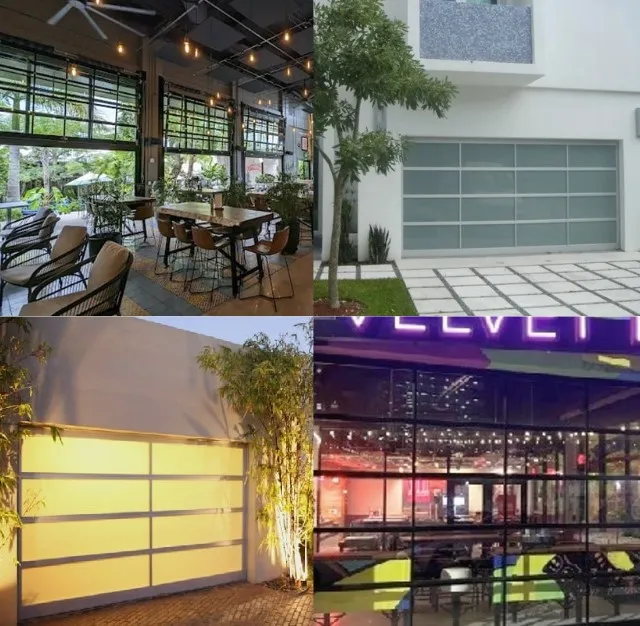
Designing HVHZ-Compliant Coastal Glass Openings: TAS 201–203Compliance
Our core competencies
Understanding TAS 201, 202, and 203 in HVHZ Design
The Frameless Fallacy: Why Unrated Open-Glass Systems Fail Coastal Compliance
Specifying for Certainty: NOA Documentation, Design Pressure, and the Hurricane Line
Common Questions
It is treated the same. The Florida Building Code classifies glass garage doors as exterior envelope openings, meaning they must carry the same TAS 201/202/203 testing and NOA approval as any window, door, or storm shutter in an HVHZ.
Yes, but only when the framing, anchoring, and glazing are engineered as a matched system and tested together under a project-specific NOA — "minimal frame" is not the same as "no frame," and the load path still has to terminate somewhere structurally sound.
TAS 202 is a static test, pressure is held steady at set intervals to measure deflection, air infiltration, and water infiltration. TAS 203 is dynamic, the same assembly is cycled through 9,000 alternating pressure loads to simulate a storm's sustained duration.
The current Miami-Dade NOA, the underlying TAS 201/202/203 test reports (not just the summary letter), the calculated design pressure for the specific site and elevation, and confirmation the tested configuration matches the proposed opening size and glazing makeup
Many are legitimately hurricane-rated, just for a lower wind-borne debris region outside the HVHZ, or under a small-missile classification. Without checking the NOA against the specific large missile impact and cyclic pressure requirements of the HVHZ, an apparently comparable product can still fail permitting.