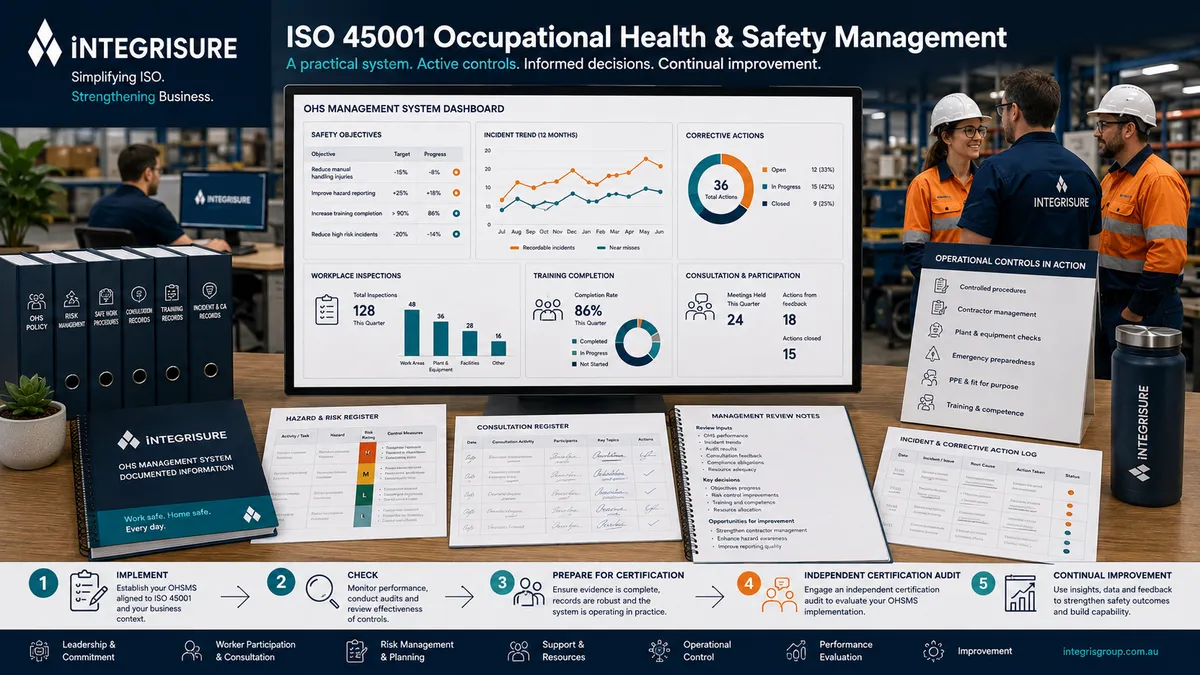
ISO 45001 Certification and Safety Management for Australian SMEs
ISO 45001 provides a structured framework for managing occupational health and safety risks and opportunities through an occupational health and safety management system.
For Australian SMEs, implementation should begin with understanding the organisation's work activities, hazards, legal and other requirements, worker needs and operational risks.
IntegriSURE supports this process with ready-to-tailor ISO 45001 management system documents, implementation guidance, checklists, progress tools and staged support options.
Rather than treating ISO certification as a paperwork exercise, the aim is to help your organisation build a system that reflects how work is actually performed, how risks are controlled and how workers are consulted and involved.
As your organisation progresses, additional guidance or support can be added for more complex implementation and certification preparation activities.
ISO 45001 certification does not guarantee legal compliance or eliminate workplace risk. Your organisation remains responsible for meeting applicable WHS obligations, and certification decisions are made independently by the certification body.
ISO 45001 for Australian SMEs: How to Build and Implement a Safety Management System
Start with Your Organisation's OH&S Context
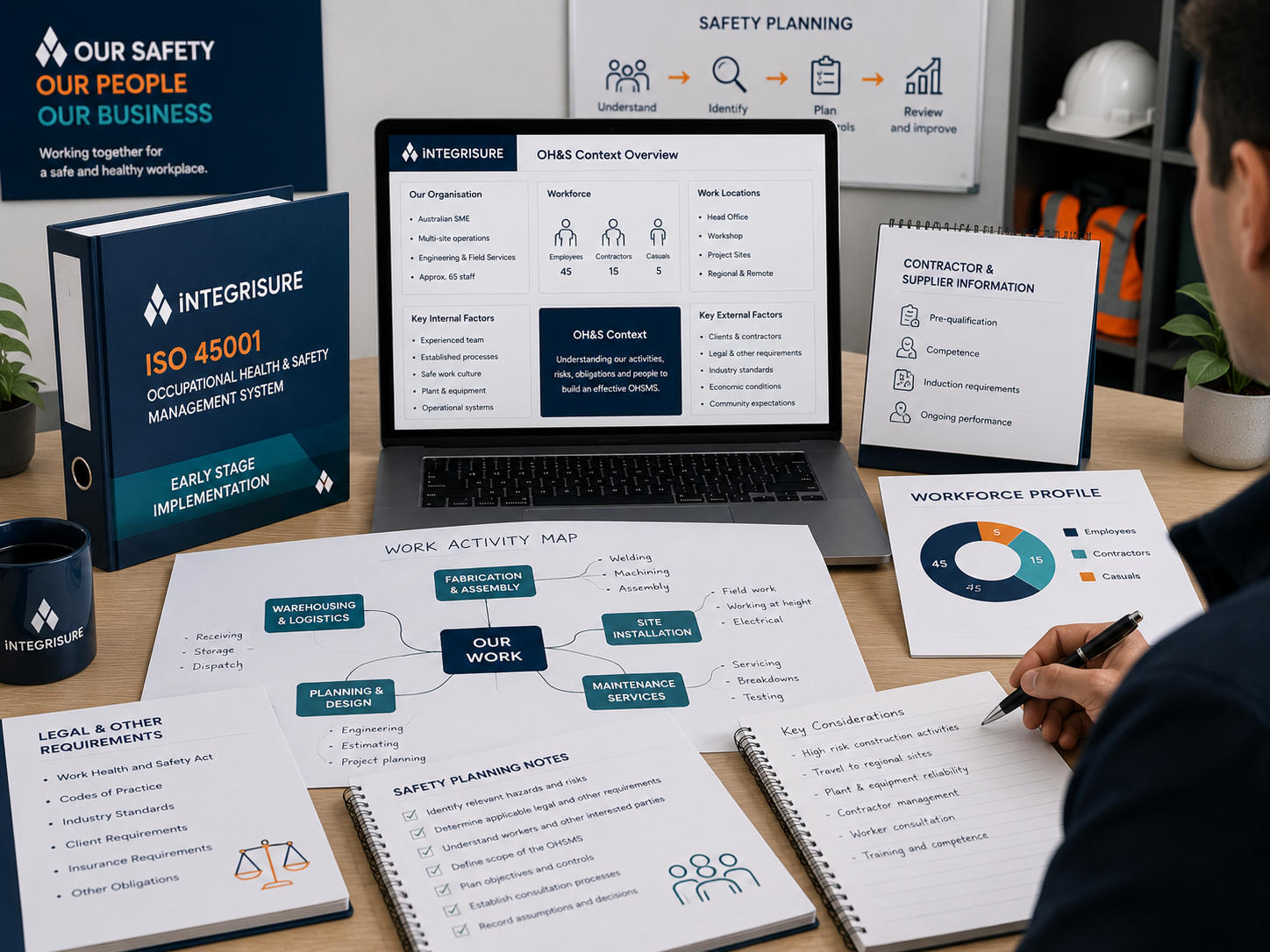
ISO 45001 implementation starts with understanding the organisation and the workplace health and safety issues that are relevant to its activities.
For an Australian SME, this means considering the nature of the work, workforce, work locations, contractors, equipment, processes, legal obligations and the needs and expectations of relevant interested parties.
The organisation should also consider internal and external factors that may affect its ability to achieve intended OH&S outcomes.
This context helps determine the scope of the occupational health and safety management system and informs later decisions about risks, objectives, controls and responsibilities.
IntegriSURE provides structured ISO 45001 management system resources that can be tailored to your organisation, but those resources still need to reflect how your business actually operates.
A practical OHSMS begins with understanding real work and real risks—not by adopting a generic safety manual and assuming the system is complete.
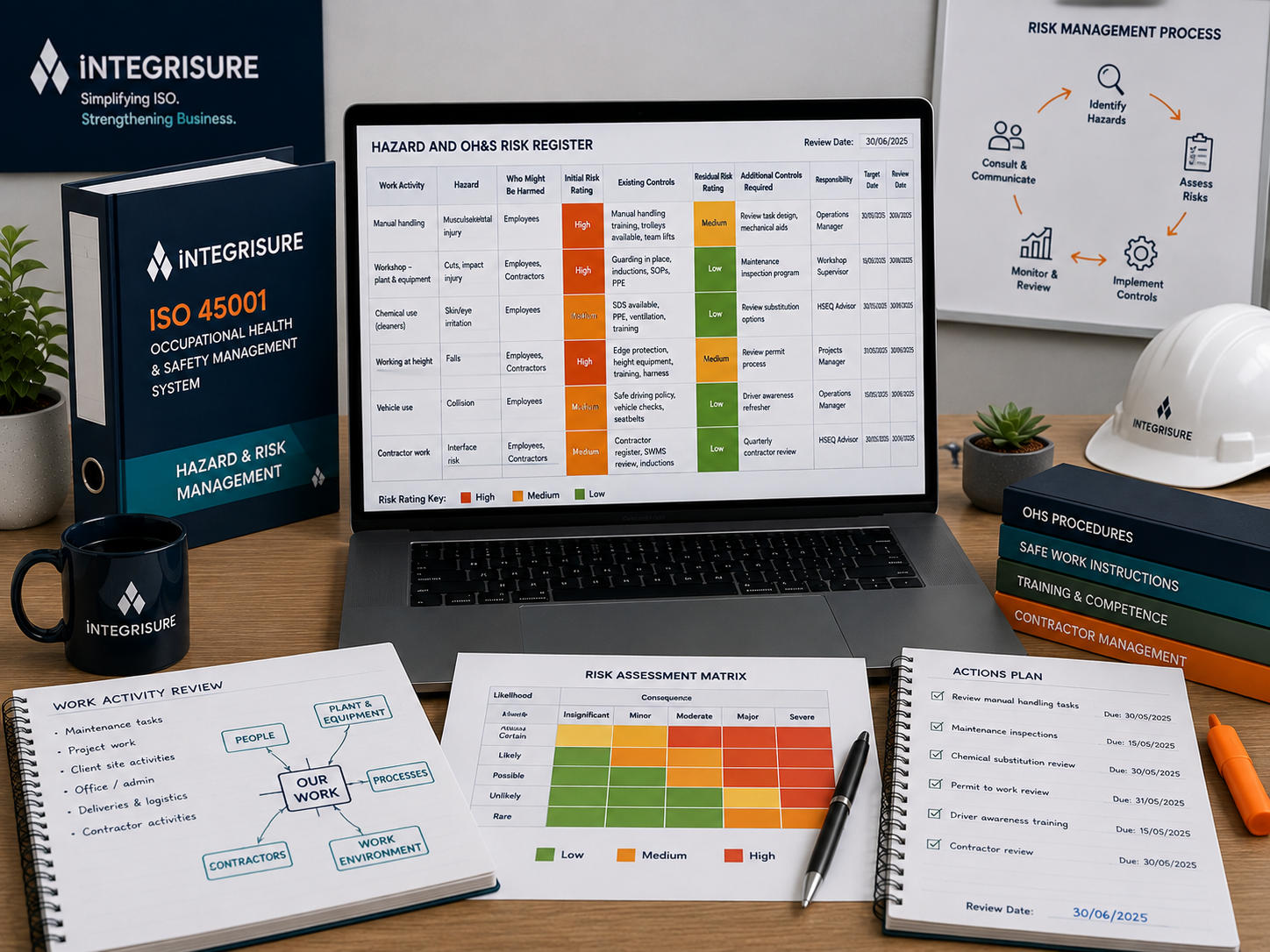
Identify Hazards and Assess OH&S Risks
Hazard identification is a fundamental part of ISO 45001.
Your organisation needs a systematic process for identifying hazards associated with routine and non-routine work, people, equipment, substances, workplaces and other relevant activities.
Examples may include manual handling, plant and machinery, hazardous substances, psychosocial hazards, working at height, vehicles, electrical risks or contractor activities.
Once hazards are identified, the organisation needs to assess OH&S risks and determine appropriate controls.
The objective is not simply to create a risk register.
The assessment should inform decisions about operational controls, responsibilities, training, monitoring and improvement activities.
This information should also be reviewed as work changes, new risks emerge or incidents identify weaknesses in existing controls.
IntegriSURE can provide structured tools and documentation to support hazard and risk management, but the assessment still needs to reflect the organisation's actual workplace conditions.
Establish Leadership Commitment and Worker Participation
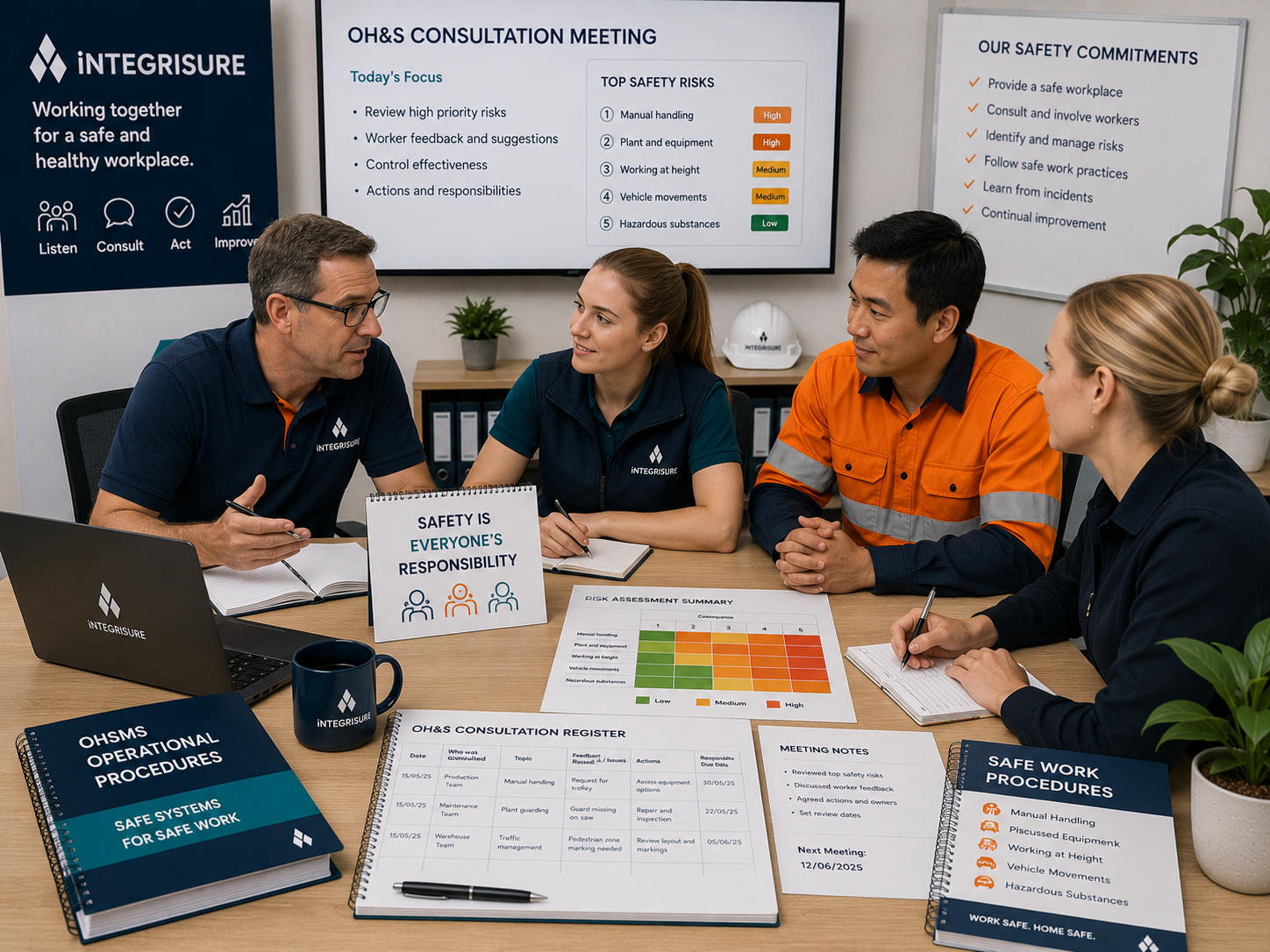
ISO 45001 places strong emphasis on leadership and worker participation.
Management needs to demonstrate that occupational health and safety is integrated into organisational decision-making rather than treated as a standalone compliance activity.
Workers also need meaningful opportunities to participate.
Depending on the organisation, this can include involvement in hazard identification, risk assessments, incident investigations, consultation processes, changes to work practices and improvement activities.
Effective consultation can also provide practical information that management may otherwise miss because workers often understand operational risks in detail.
The organisation should establish processes that support consultation and participation and address barriers that could prevent workers from contributing.
IntegriSURE's management system documents can provide a structure for responsibilities and consultation processes, but the organisation needs to make those processes real.
A consultation procedure has limited value if workers do not actually have opportunities to participate in relevant OH&S decisions.
Maintain: Ensuring Continuous Improvement
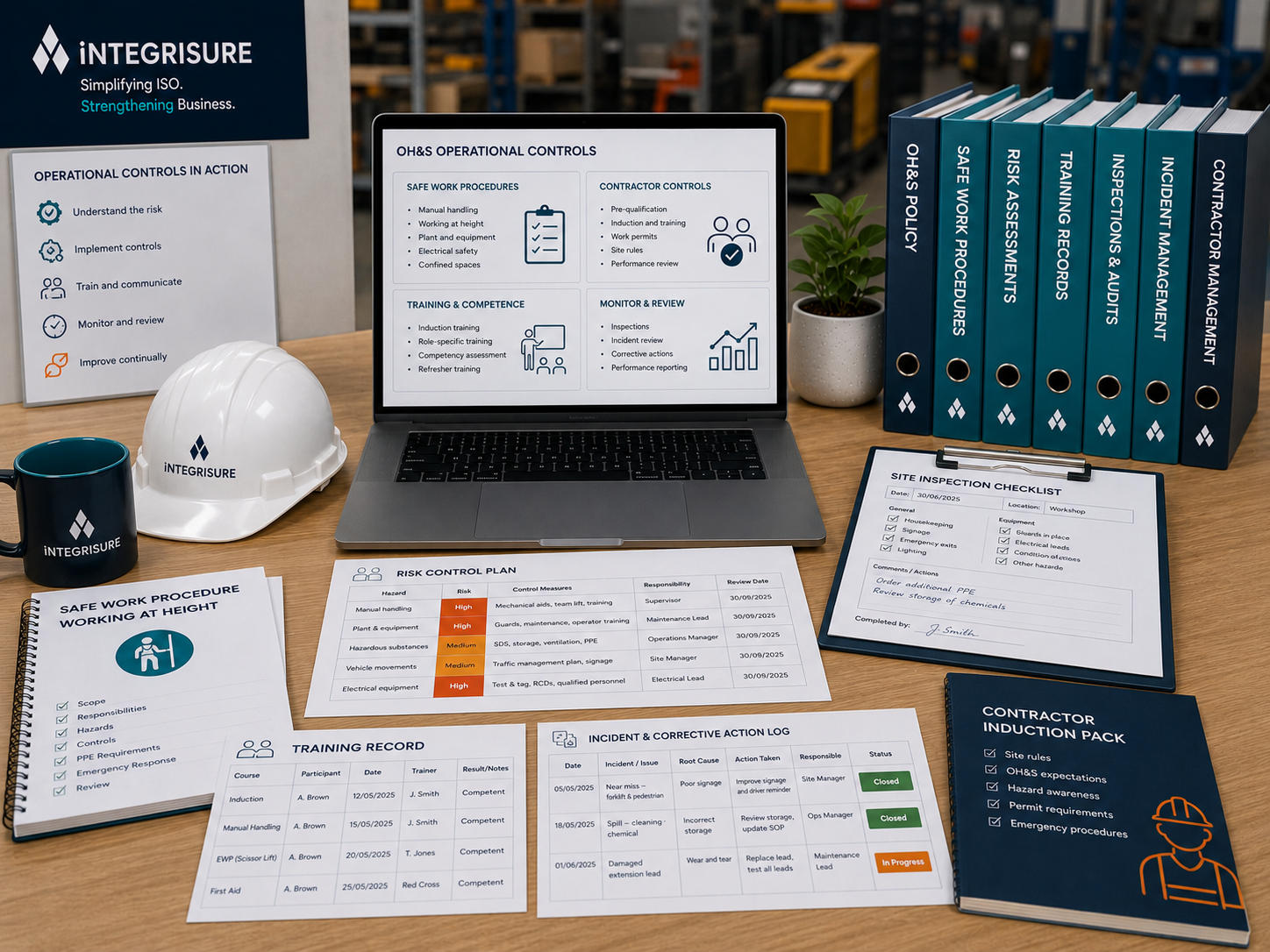
Once OH&S risks have been identified, appropriate controls need to be implemented within daily operations.
The required controls depend on the organisation's actual activities and risks.
They may involve procedures, safe systems of work, equipment controls, contractor management, procurement, maintenance, emergency preparedness, workplace inspections or other operational measures.
Relevant employees and contractors need to understand the controls that apply to their work.
Where competence is required, the organisation needs to ensure people have the appropriate knowledge, training or experience.
This is where the occupational health and safety management system moves from documentation into operation.
A procedure sitting in a folder does not control a workplace risk unless the process it describes is actually understood and followed.
IntegriSURE's implementation resources are intended to help SMEs progressively embed their management system processes into operations rather than simply collect safety documentation.
Organisations wanting to build internal understanding can also use the Demystifying ISO courses as part of their capability-building approach.
Manage Incidents, Nonconformities and Corrective Actions
Even with a structured safety management system, incidents and process failures can occur.
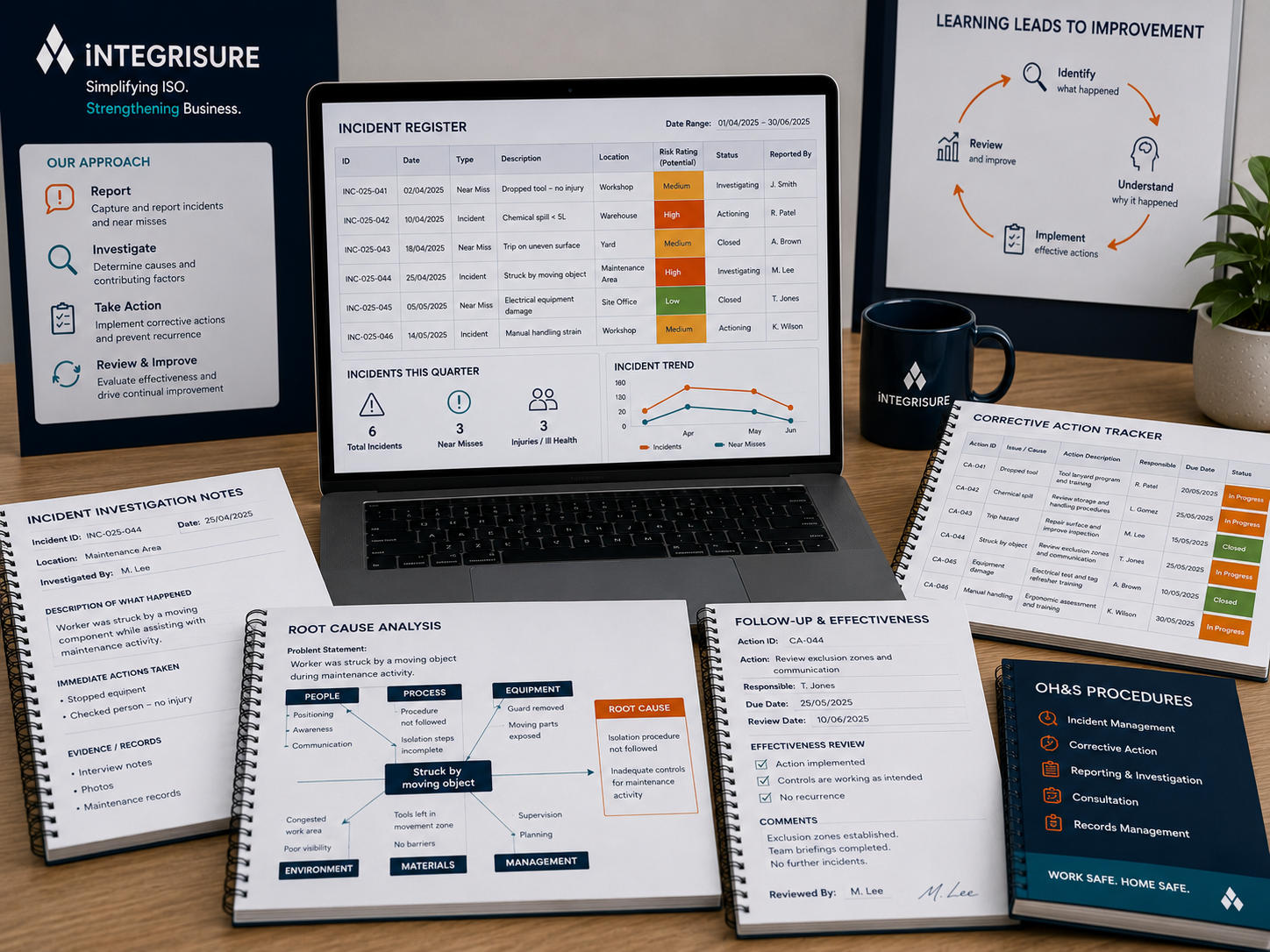
ISO 45001 requires organisations to establish processes for responding to incidents and nonconformities.
This should include taking appropriate immediate action, investigating what occurred where relevant, determining whether similar issues could exist elsewhere and taking corrective action when required.
The purpose is not simply to complete an incident form.
The organisation should use incidents and nonconformities as opportunities to understand weaknesses in the system and improve controls.
Records of investigations, decisions, actions and follow-up can also provide evidence that the management system is operating.
For SMEs, maintaining a clear corrective action process can help prevent issues from being forgotten once the immediate problem has been addressed.
It also supports continual improvement by connecting workplace events with changes to controls, procedures, training or other management system components.
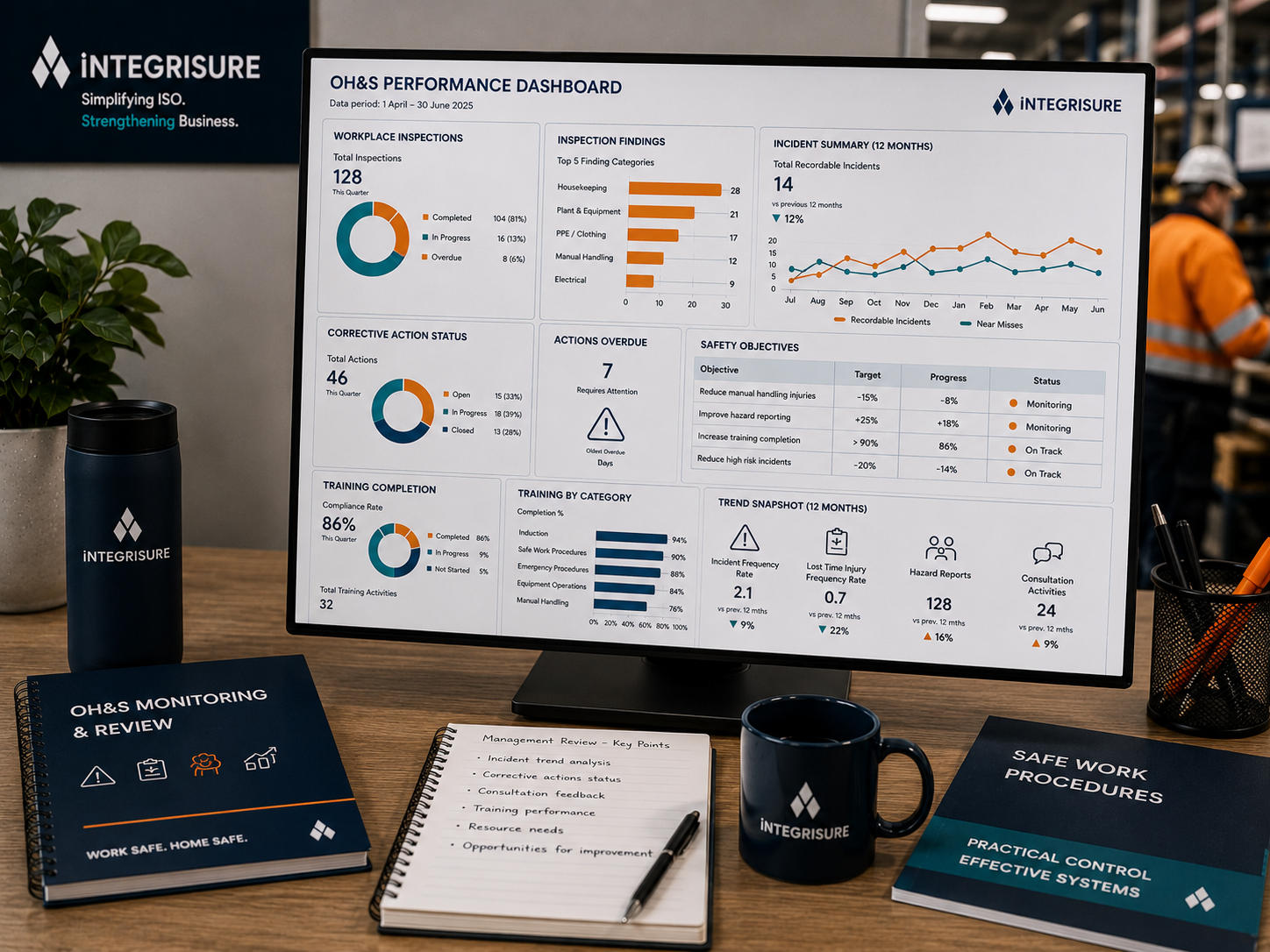
Monitor OH&S Performance
An effective OHSMS needs information about whether its controls and processes are working.
The organisation should determine what needs to be monitored and measured and how the results will be evaluated.
Depending on the organisation, this could include inspection results, incidents, hazards reported, corrective actions, consultation activity, training, health monitoring where relevant, objectives or other OH&S performance measures.
The goal should not be to create dashboards for their own sake.
Monitoring needs to provide useful information that supports decisions and improvement.
Where results indicate that controls are not performing as intended, the organisation should determine what further action is required.
This creates a practical feedback loop between planning, operation and improvement.
As the OHSMS matures, monitoring information also becomes useful input into internal audits, management review and later certification preparation.
Check the OHSMS Through Internal Audit and Management Review
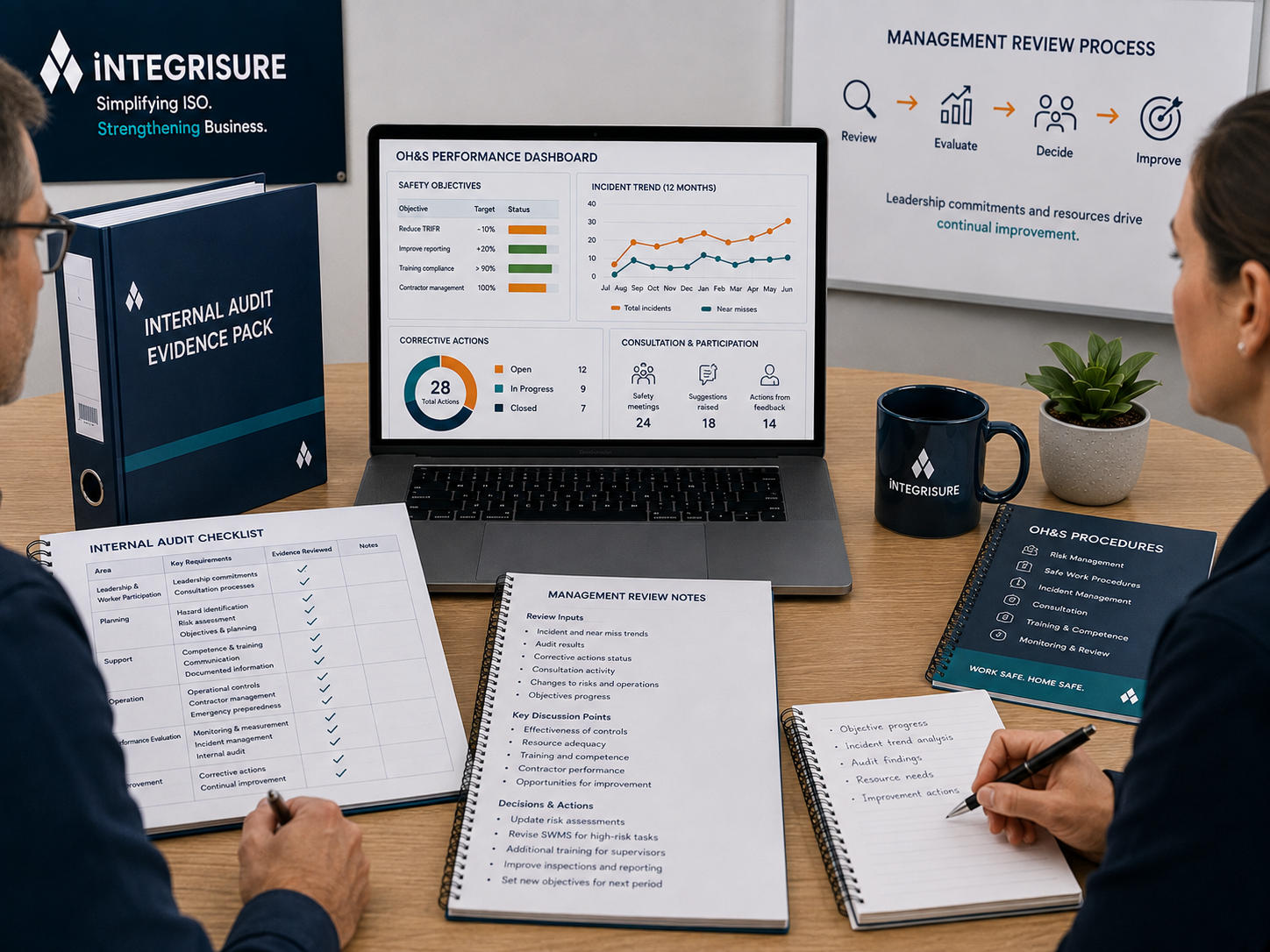
Before moving toward external certification, the organisation needs to evaluate whether its occupational health and safety management system is operating as intended.
Internal audit provides a structured method for evaluating conformity and implementation.
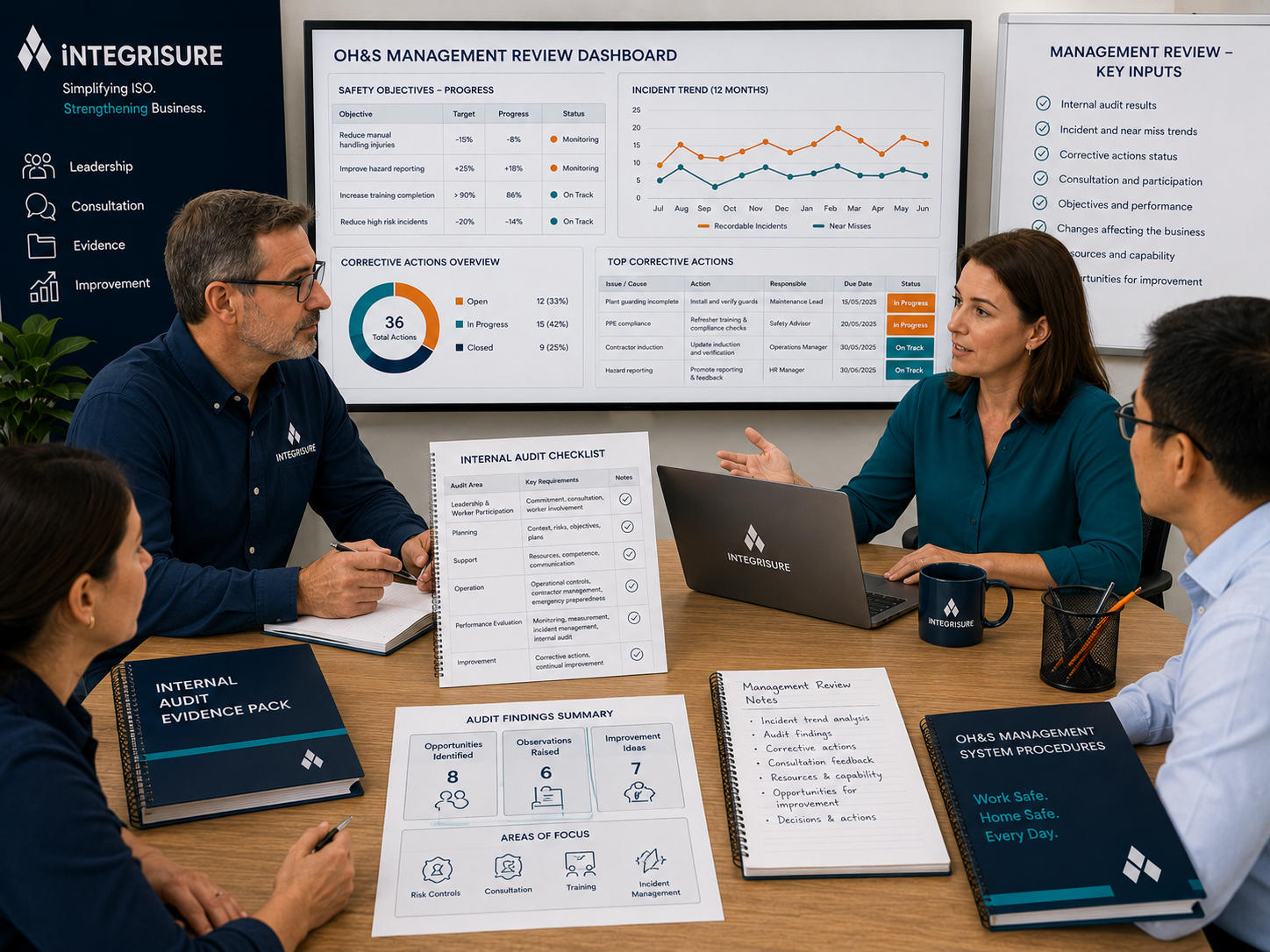
Management review then allows leadership to consider the overall performance, continuing suitability and effectiveness of the system.
Relevant information can include audit findings, incident trends, objectives, worker consultation, corrective actions, monitoring results, changes affecting the organisation and opportunities for improvement.
These activities are not simply pre-audit tasks.
They are important governance mechanisms that help management understand whether the OHSMS is actually working.
Where gaps are identified, the organisation should address them and maintain appropriate evidence of actions taken.
This helps SMEs approach later certification activities with a clearer understanding of system performance rather than relying on assumptions or document completion alone
Check the OHSMS Through Internal Audit and Management Review
Before moving toward external certification, the organisation needs to evaluate whether its occupational health and safety management system is operating as intended.
Internal audit provides a structured method for evaluating conformity and implementation.
Management review then allows leadership to consider the overall performance, continuing suitability and effectiveness of the system.
Relevant information can include audit findings, incident trends, objectives, worker consultation, corrective actions, monitoring results, changes affecting the organisation and opportunities for improvement.
These activities are not simply pre-audit tasks.
They are important governance mechanisms that help management understand whether the OHSMS is actually working.
Where gaps are identified, the organisation should address them and maintain appropriate evidence of actions taken.
This helps SMEs approach later certification activities with a clearer understanding of system performance rather than relying on assumptions or document completion alone.
Prepare for Independent ISO 45001 Certification
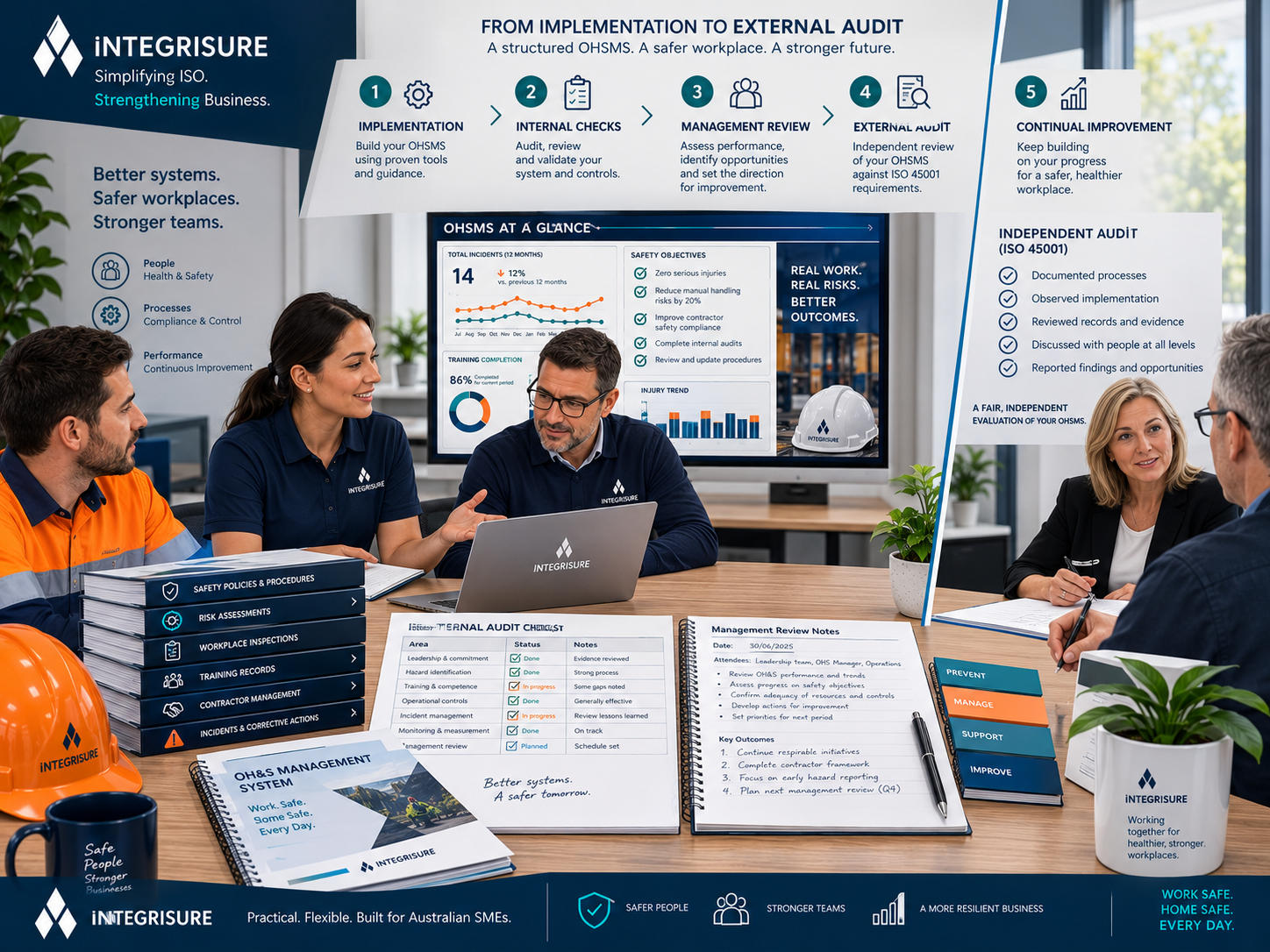
Once the OHSMS has been implemented, operated and evaluated, the organisation can progress toward external ISO certification.
Certification preparation should focus on ensuring that documented information is current, records are accessible, relevant internal audit and management review activities have been completed and known issues have been appropriately addressed.
Relevant employees should understand the processes and responsibilities connected to their work.
They do not need rehearsed answers. They should be able to explain how OH&S processes operate in practice.
The certification audit is then undertaken independently by a certification body.
The certification body evaluates the management system against applicable requirements and determines the certification outcome through its own processes.
IntegriSURE can support management system implementation and certification preparation, but it does not issue ISO 45001 certification or guarantee the audit result.
After certification, the organisation needs to continue monitoring, auditing, reviewing and improving the OHSMS over time.
For organisations implementing multiple standards, this later-stage pathway may also involve implementing an integrated management system that brings quality, environmental and OH&S requirements together where appropriate.
Frequently Asked Questions
ISO 45001 is an international management system standard for occupational health and safety.
It provides a framework for identifying hazards, managing OH&S risks and opportunities, consulting and involving workers, establishing operational controls and improving OH&S performance.
For a broader introduction, see ISO 45001 Safety Management: Protecting Your Team.
ISO 45001 certification is generally voluntary.
However, customers, tenders, principal contractors, supply chains or contractual arrangements may require certification or evidence of a structured safety management system.
Your organisation should confirm the specific requirements that apply to its operations. You can also review who benefits from ISO when considering whether certification is appropriate for your business.
No.
ISO 45001 requires organisations to establish processes for identifying and managing applicable legal and other requirements, but the organisation remains responsible for meeting those obligations.
Certification does not provide a legal compliance guarantee. For further context, see What Is ISO Compliance?
Key areas include organisational context, leadership, worker consultation and participation, hazard identification, OH&S risk and opportunity management, objectives, operational controls, competence, communication, incident management, performance monitoring, internal audit, management review and continual improvement.
IntegriSURE provides ready-to-tailor management system documents and structured implementation resources.
Depending on your selected pathway, this can include implementation guidance, checklists, facilitation tools, progress tracking and additional support as the organisation moves toward later certification activities.
Organisations at an early stage can also begin with the ISO Starter Pack to better understand the broader certification journey.
Worker consultation and participation are important elements of ISO 45001.
Organisations need to establish processes that allow workers to contribute to relevant OH&S decisions, hazard identification, incident learning and improvement activities.
Yes.
ISO 45001 can be integrated with ISO 9001 and ISO 14001 within an integrated management system where this suits the organisation.
This can help reduce duplicated processes while still addressing the specific OH&S requirements of ISO 45001.
No.
IntegriSURE supports management system development, implementation and certification preparation. The external audit and certification decision remain with the independent certification body.
The seven stages of certification provide further context on how certification fits within the broader management system journey.