ISO 14001 Certification and Environmental Management for Australian SMEs

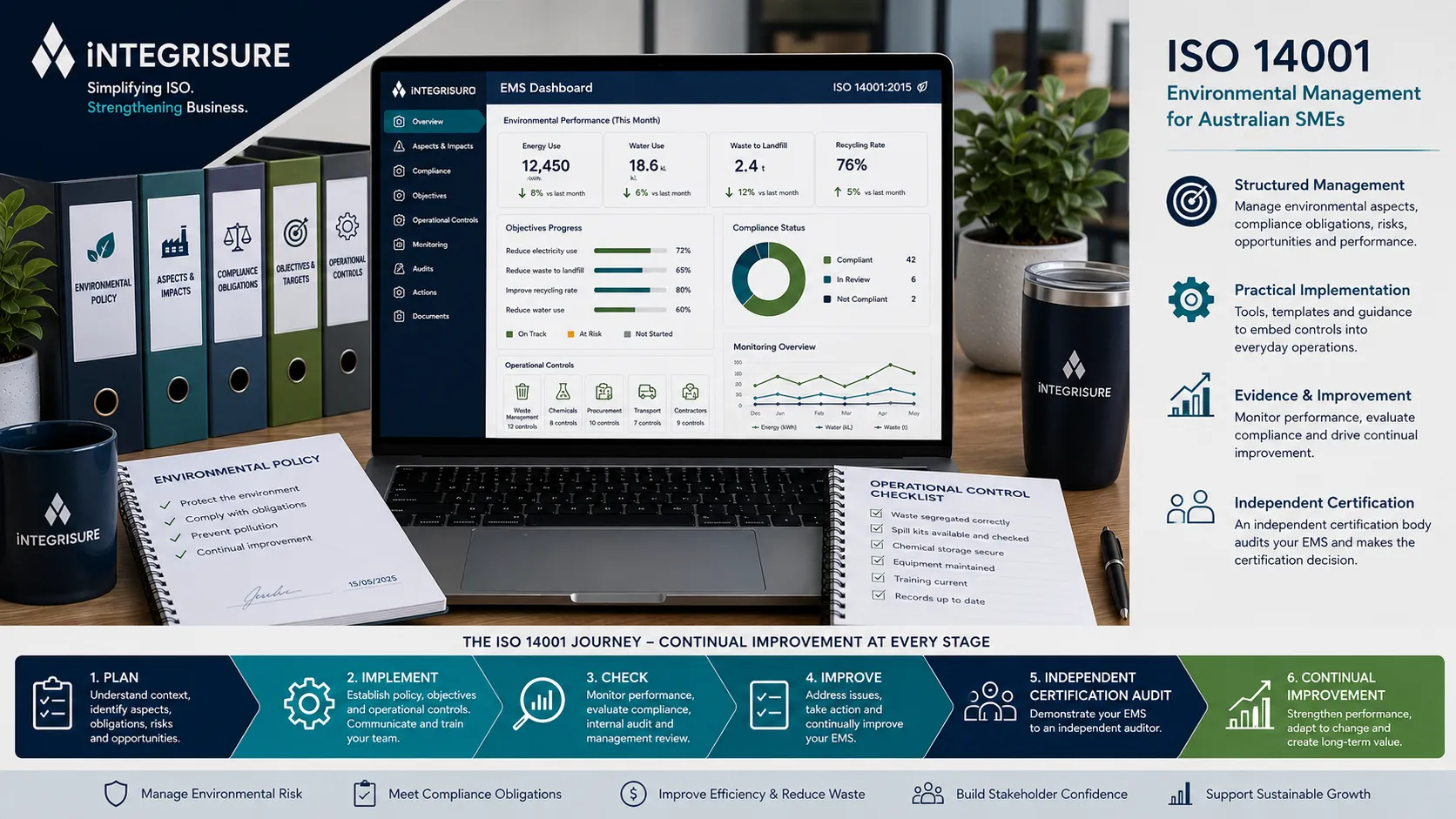
ISO 14001 provides a structured framework for organisations to manage environmental responsibilities, risks, opportunities and performance through an environmental management system.

For Australian SMEs, implementation starts with understanding the organisation's context, identifying environmental aspects and impacts, determining applicable compliance obligations and establishing appropriate objectives and controls.

IntegriSURE supports this process with ready-to-tailor ISO 14001 management system documents, implementation guidance, checklists, progress tools and staged support options.

Rather than treating ISO certification as a paperwork exercise, the aim is to help your organisation build a system that reflects its actual environmental activities and progressively embed that system into operations.

As your organisation moves forward, additional support can be added for more complex implementation and certification preparation activities.

ISO 14001 certification does not itself guarantee environmental or legal compliance. Your organisation remains responsible for meeting applicable obligations, and certification decisions are made independently by the certification body.

ISO 14001 for Australian SMEs: How to Build and Implement an Environmental Management System

Start with Your Organisation's Environmental Context

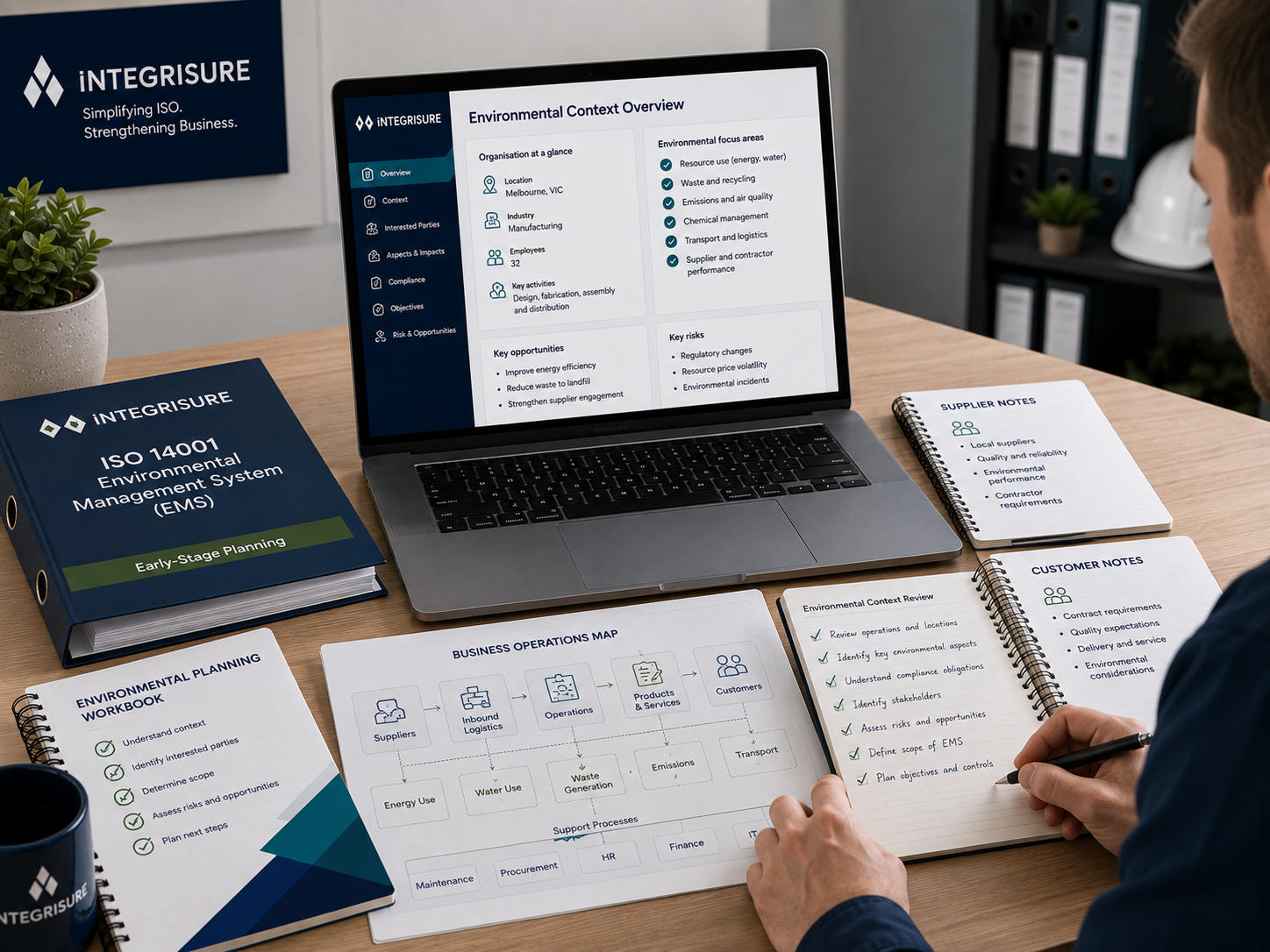
ISO 14001 implementation should begin with understanding the organisation and the environmental issues that are relevant to its activities. For an Australian SME, this means looking beyond generic sustainability statements. Consider where your organisation operates, the nature of its products or services, the resources it uses, the waste it generates, relevant emissions, transport, procurement, storage, emergency scenarios and other environmental interactions. You should also consider interested parties that may influence the management system, such as customers, regulators, landlords, suppliers, local communities or tendering organisations. This context helps determine the scope of the environmental management system and informs later decisions about risks, opportunities, objectives and operational controls. IntegriSURE provides structured ISO 14001 management system resources that can be tailored to your organisation, but those resources need to reflect your actual operating environment. A meaningful EMS starts with understanding what matters environmentally to your business—not by copying a generic environmental policy and assuming the system is complete.
Start with Your Organisation's Environmental Context

Identify Environmental Aspects and Impacts

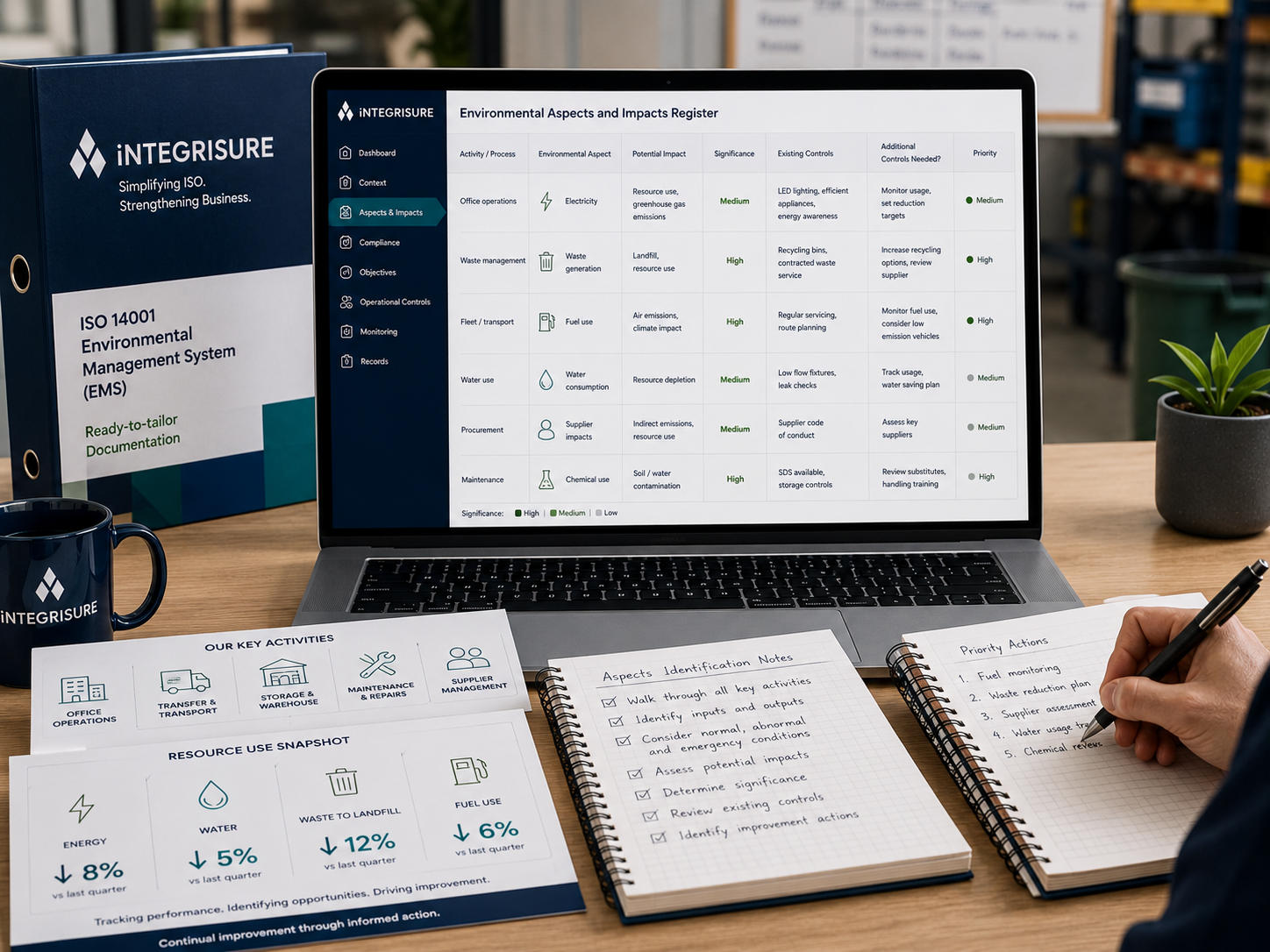
A core part of ISO 14001 is understanding how your organisation interacts with the environment. An environmental aspect is something within your activities, products or services that can interact with the environment. The impact is the change that can result from that interaction. For example, using electricity is an aspect. The associated resource use and emissions may represent environmental impacts. Other examples might include fuel consumption, waste generation, chemical storage, water use, packaging, transport, emissions or procurement choices. Your organisation needs a systematic approach to identifying these aspects and determining which ones are significant within the context of your EMS. This assessment should be relevant to your real operations and maintained as circumstances change. IntegriSURE's environmental management resources can provide structure for this process, including tools that help organisations capture and assess environmental aspects. The value of the exercise is not simply producing a register. The outcome should inform your planning, objectives, controls, monitoring and improvement activities.
Identify Environmental Aspects and Impacts

Identify and Manage Compliance Obligations

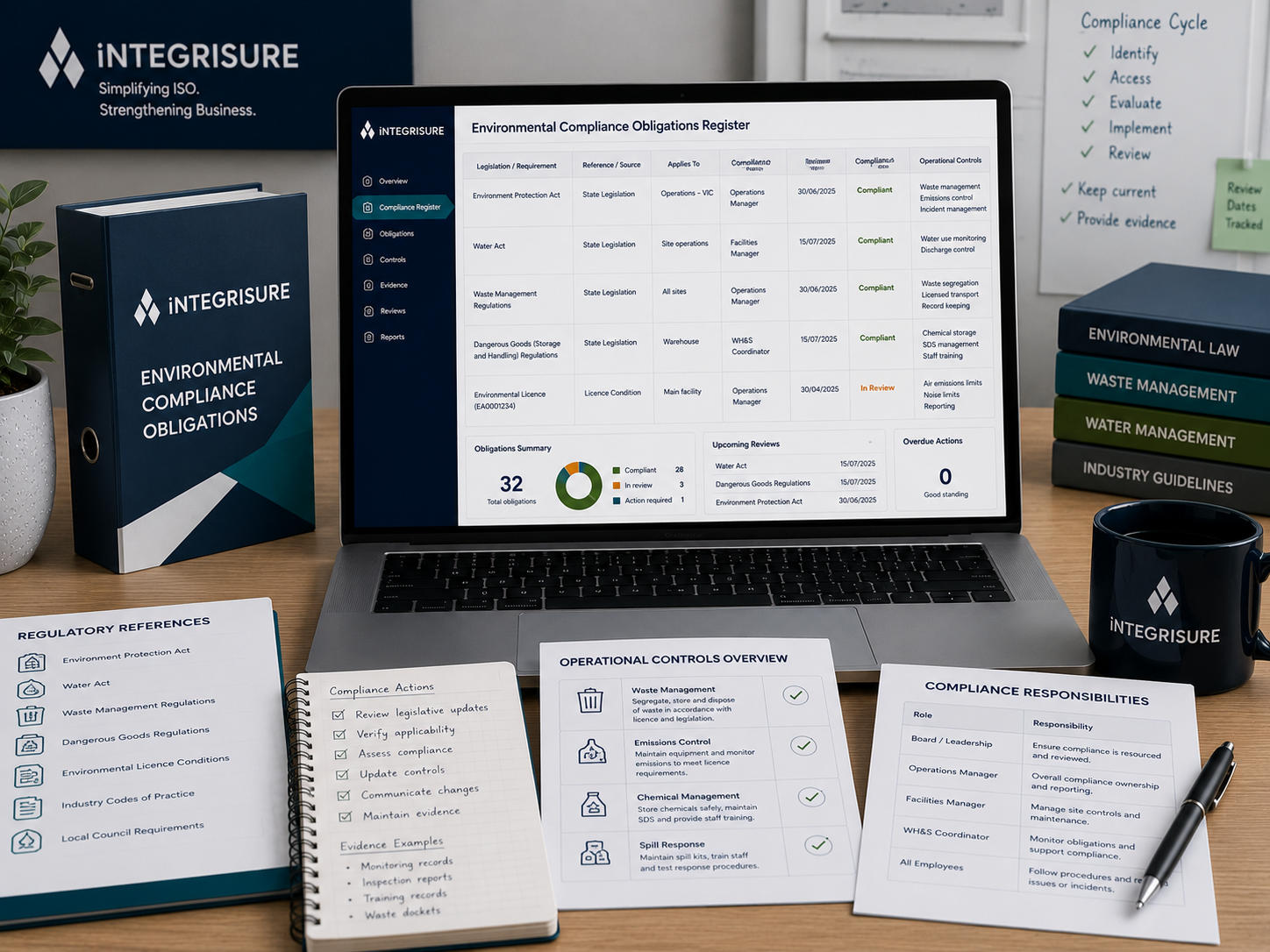
Environmental management also requires your organisation to understand the compliance obligations relevant to its activities. These may include applicable environmental legislation, licence or permit conditions, regulatory requirements, contractual commitments or other requirements the organisation has chosen to adopt. ISO 14001 does not automatically determine these obligations for you. Your organisation needs a process for identifying relevant requirements, understanding how they apply and keeping that information current. The EMS should also establish how applicable obligations influence operational planning and controls. Over time, the organisation needs to evaluate whether those obligations are being met and maintain appropriate knowledge of its compliance status. This is an important distinction: ISO 14001 certification does not guarantee legal compliance. Instead, the standard requires a structured management process for understanding and managing compliance obligations. For further context, see What Is ISO Compliance? For SMEs, having this information organised within the management system can help reduce uncertainty and provide clearer accountability for environmental responsibilities.
Identify and Manage Compliance Obligations

Establish Your Environmental Policy and Objectives

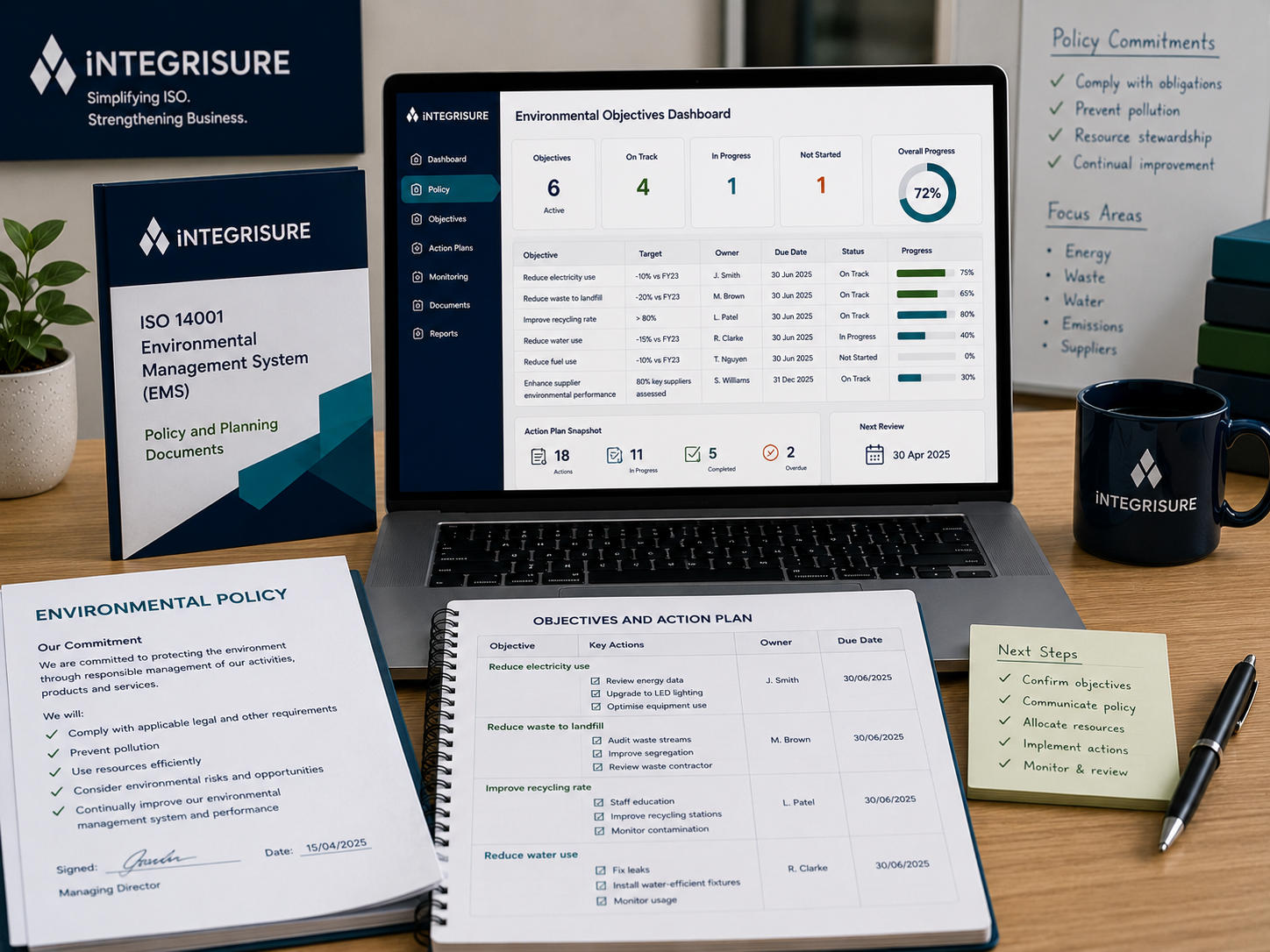
The environmental policy sets the overall direction of your environmental management system. It should reflect your organisation's purpose and context and include the commitments required by ISO 14001, including environmental protection, fulfilment of compliance obligations and continual improvement of the environmental management system to enhance environmental performance. But the policy should not stand alone. Your organisation also needs meaningful environmental objectives that translate those commitments into practical priorities. Objectives might relate to areas such as resource use, waste, emissions, operational controls, supplier management or other significant environmental considerations relevant to your business. Where objectives are established, the organisation should determine what will be done, what resources are required, who is responsible, when the work will be completed and how results will be evaluated. For SMEs, this helps turn broad environmental intentions into manageable actions. IntegriSURE provides ready-to-tailor policy and planning documents that establish a structured foundation, but the objectives and commitments need to make sense for your organisation.
Establish Your Environmental Policy and Objectives

Implement Operational Controls

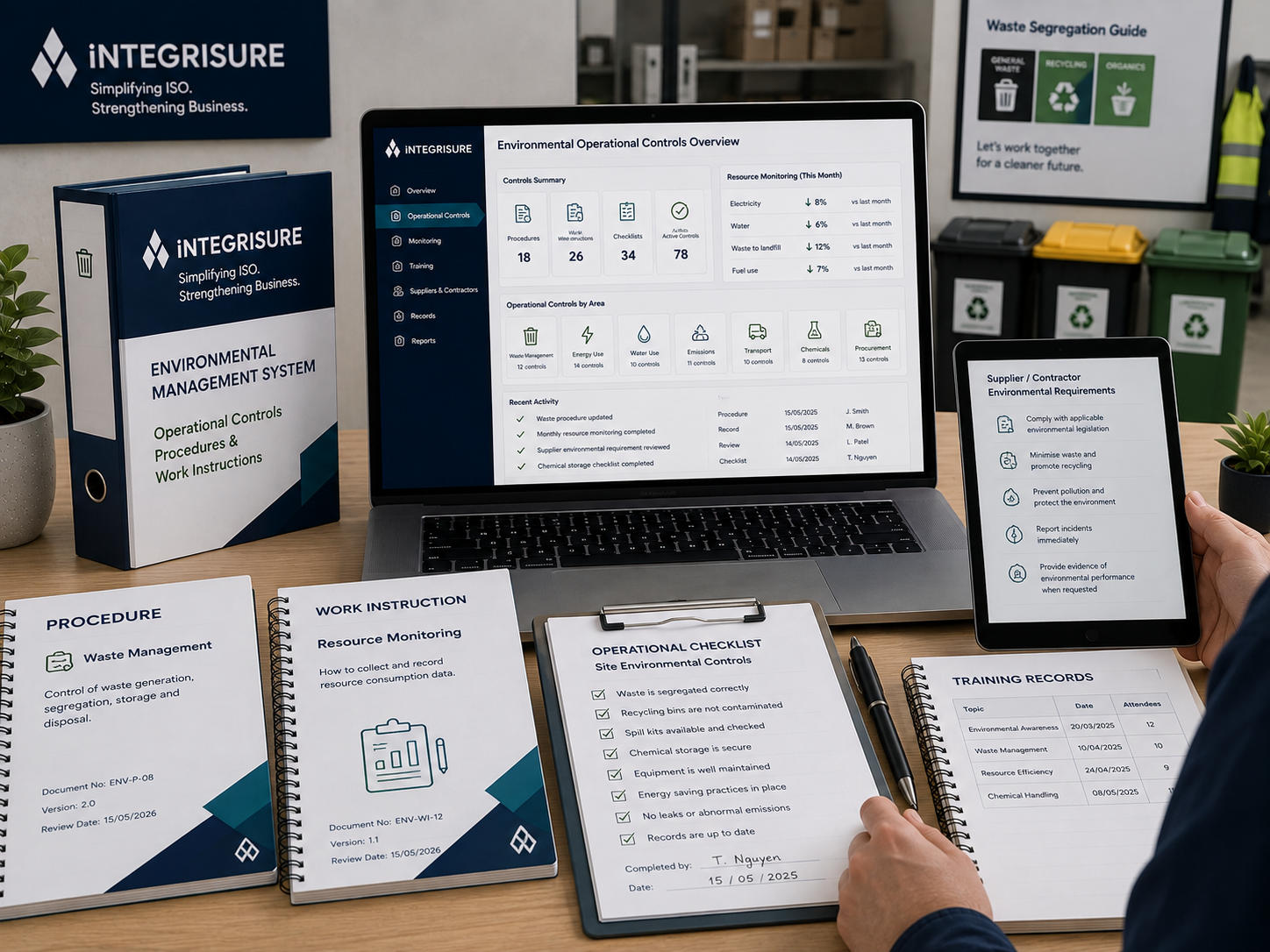
Once environmental priorities have been identified, the organisation needs to establish the processes and controls required to manage them. Operational controls will vary considerably between businesses. A professional services firm may focus on procurement, energy use, waste and office management, while a manufacturing or construction business may require more detailed controls around chemicals, emissions, waste streams, equipment, transport or contractors. The important point is that controls should address the organisation's actual significant environmental aspects, compliance obligations, risks and opportunities. Relevant employees should understand what is expected and be competent to perform activities that can affect environmental performance. Where outsourced processes are relevant, the organisation should also consider how environmental requirements are communicated and controlled. This is where the EMS moves from planning into everyday operation. IntegriSURE's implementation resources are designed to help SMEs progressively embed policies, procedures and supporting tools into operational practice rather than treating documentation as the final result. For organisations building internal capability, the Demystifying ISO courses can also support a clearer understanding of management system principles.
Implement Operational Controls

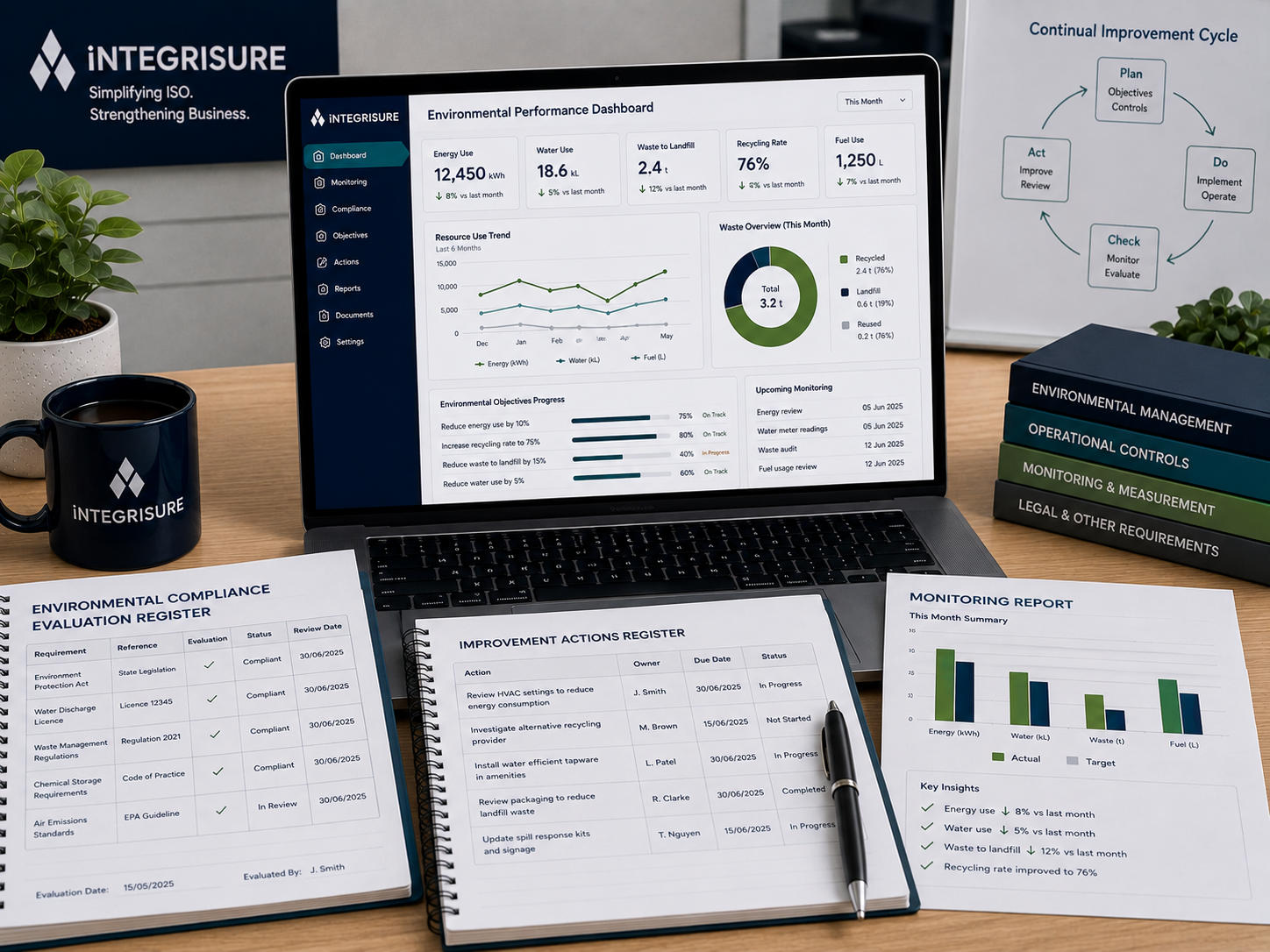
Monitor Environmental Performance and Evaluate Compliance

An environmental management system needs information about how it is performing. Your organisation should determine what needs to be monitored and measured, how the information will be collected and how results will be evaluated. This might include data relating to energy, water, waste, emissions, incidents, environmental objectives or other indicators relevant to the organisation. Monitoring should support decisions rather than simply generate data. The organisation also needs to periodically evaluate fulfilment of its compliance obligations and maintain knowledge of its compliance status. Where performance does not meet expectations, or where issues are identified, appropriate corrective and improvement actions may be required. For SMEs, this creates a practical feedback loop. Rather than assuming environmental controls are working, the business uses evidence to understand performance and determine where action is needed. These records also become part of the evidence demonstrating that the environmental management system is operating in practice.
Monitor Environmental Performance and Evaluate Compliance

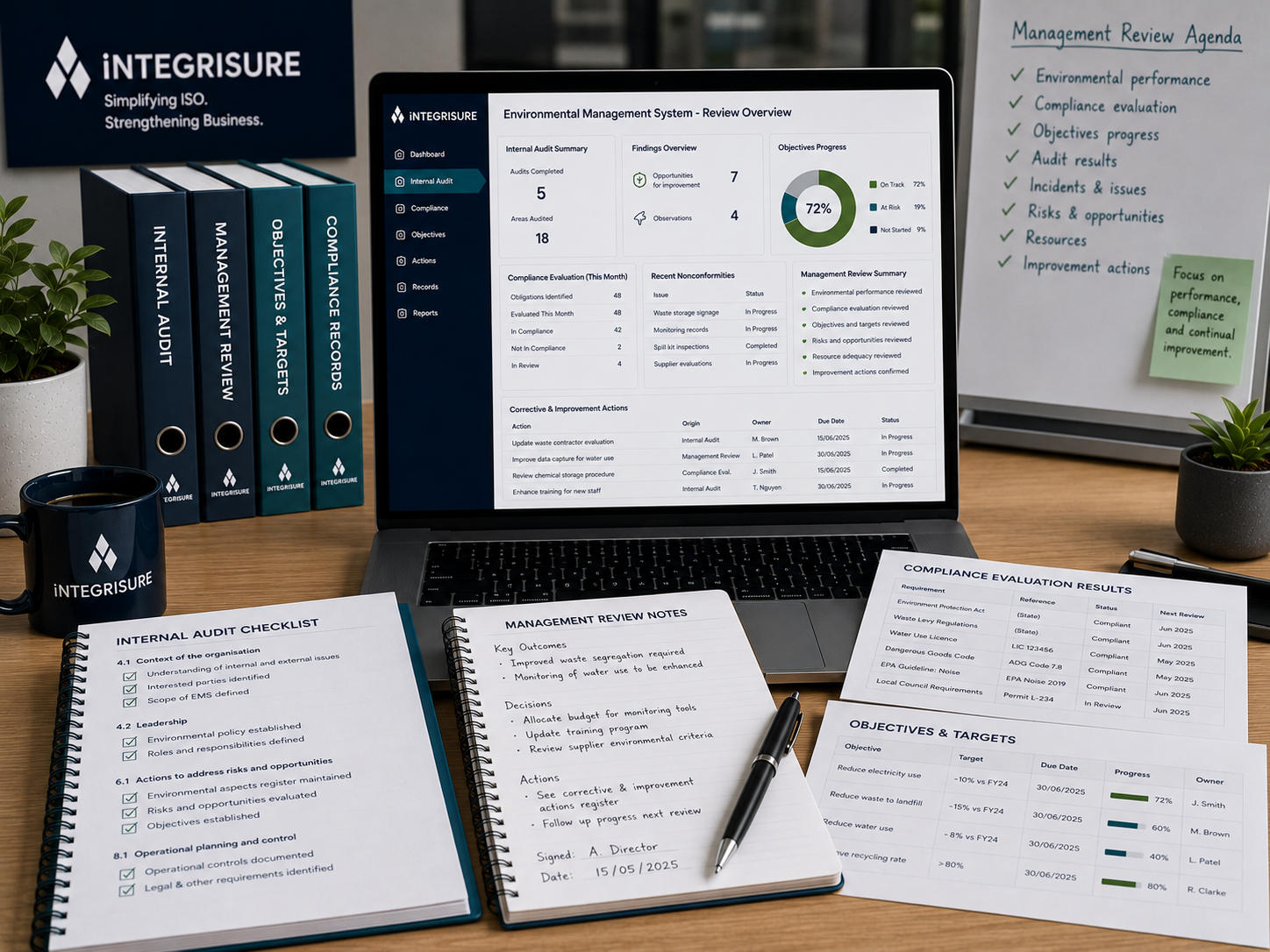
Check the EMS Through Internal Audit and Management Review

Before progressing to external certification, your organisation needs to evaluate its own environmental management system. Internal audit provides a structured way to determine whether the EMS conforms to relevant requirements and whether it has been effectively implemented and maintained. Management review then gives leadership the opportunity to consider the performance and continuing suitability of the system. This can include environmental performance, progress against objectives, audit results, compliance evaluation, nonconformities, changing circumstances, resource needs and opportunities for improvement. These activities should not be treated simply as pre-certification paperwork. They are important management processes that help identify gaps and drive improvement before and after certification. Where issues are identified, the organisation should address them and retain evidence of appropriate actions. IntegriSURE can provide structure and resources to support the broader certification journey, while responsibility for evaluating and improving the management system remains with the organisation.
Check the EMS Through Internal Audit and Management Review

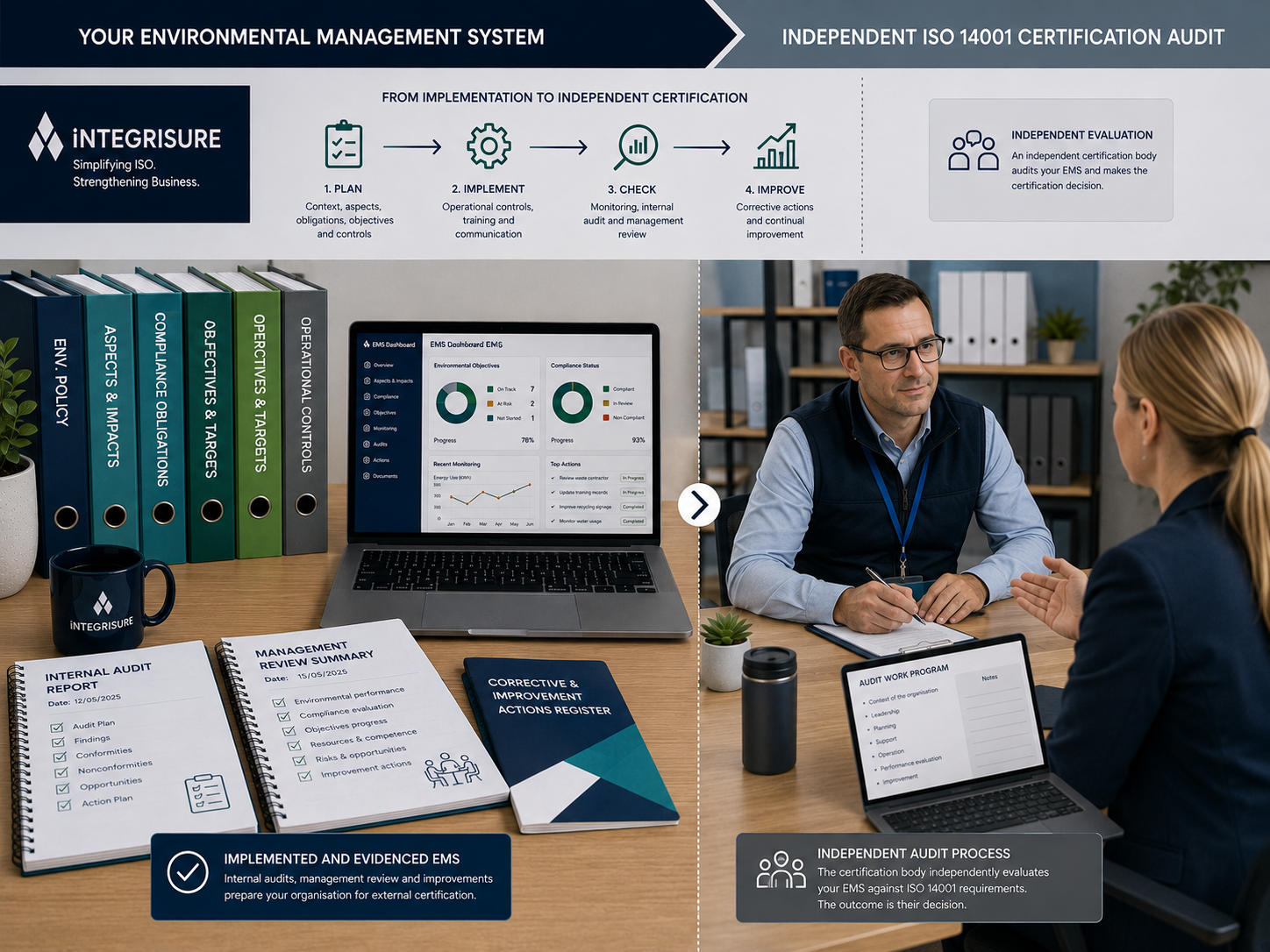
Prepare for Independent ISO 14001 Certification

Once the environmental management system has been established, implemented and evaluated, the organisation can move toward external ISO certification. Certification preparation should focus on ensuring that documented information is current, evidence can be retrieved, relevant internal audit and management review activities have been completed and known issues have been appropriately addressed. Relevant employees should understand the processes and environmental responsibilities connected to their work. They do not need scripted responses. They should be able to explain how the system operates in practice. The certification audit is then undertaken by an independent certification body. The auditor evaluates the EMS against applicable certification requirements and records findings through the certification body's process. IntegriSURE can support the organisation's journey and preparation, but it does not issue ISO 14001 certification or guarantee the audit outcome. After certification, the environmental management system continues. Monitoring, audits, management reviews, corrective actions and continual improvement remain part of maintaining an effective EMS over time. For organisations considering how ISO 14001 may later sit alongside quality or safety management, IntegriSURE also provides guidance on implementing integrated management systems.
Prepare for Independent ISO 14001 Certification

Frequently Asked Questions

ISO 14001 is an international management system standard that specifies requirements for an environmental management system, or EMS. It provides a structured framework for identifying environmental aspects, managing risks and opportunities, addressing compliance obligations, monitoring performance and pursuing continual improvement.

Generally, ISO 14001 certification is voluntary. However, customers, tenders, supply chains or contractual arrangements may require certification or evidence of a structured environmental management system. Organisations should confirm the specific requirements that apply to their situation. You can also review who benefits from ISO when considering the business case for certification.

No. ISO 14001 requires organisations to establish processes for identifying, accessing and evaluating applicable compliance obligations. The organisation remains responsible for meeting those obligations. Certification does not remove that responsibility or guarantee legal compliance. The distinction between certification and compliance is explained further in What Is ISO Compliance?

An environmental aspect is an element of an organisation's activities, products or services that can interact with the environment. An environmental impact is the resulting change to the environment. For example, energy consumption may be an aspect, while associated greenhouse gas emissions may be an impact.

The specific documented information will depend on your organisation, but it can include environmental policies, aspects and impacts registers, compliance obligation registers, objectives, operational controls, monitoring records, emergency preparedness processes, internal audit records and management review outputs.

IntegriSURE provides ready-to-tailor environmental management system documents and staged implementation resources. Depending on your selected pathway, this can include implementation guidance, checklists, facilitation tools, progress tracking and additional support as the organisation moves toward later certification activities. Organisations new to the process can also begin with the ISO Starter Pack to better understand the broader certification journey.

Yes. ISO 14001 can be integrated with ISO 9001 and ISO 45001 within a broader integrated management system where this suits the organisation. This can help reduce duplicated processes while still addressing the specific environmental requirements of ISO 14001.

No. IntegriSURE supports management system development, implementation and certification preparation. The external audit and final certification decision remain with the independent certification body. The seven stages of certification provide further context on how external certification fits within the broader management system journey.