Understanding Performance Ratings for Hurricane Glass Garage Doors

The garage door represents the single largest penetration in a building's exterior envelope, and its flexibility under load makes it the most vulnerable point of failure during a high-wind event. When an opening of that size gives way, pressurized air floods the structure, forcing the roof and wall assemblies to absorb dramatically increased loads. That is why wind rating and impact rating figures carry genuine engineering weight for architects, specifiers, and developers — and why a vague "hurricane rated" label tells you almost nothing useful. Every legitimate rating traces back to a controlled laboratory test: a specific design pressure value, a defined projectile traveling at a set velocity, a prescribed series of cyclic pressure loading cycles, and an objective pass/fail result recorded by an accredited third party. For Glass Garage Door Systems, where expansive glazed sections replace solid panels, knowing exactly what each test protocol evaluates separates a sound, defensible specification from an uninformed assumption. bp Glass Garage Doors & Entry Systems' Hurricane Line is built around these established test standards, and the sections that follow break down what each one actually measures.

How Performance Ratings Are Measured for Glass Garage Door Systems

Design Pressure: Quantifying the Structural Load Requirement

Design pressure represents the wind-induced force per square foot (psf) that a door assembly must sustain without structural failure. This figure is not arbitrary — it is calculated from site-specific variables including the governing code's baseline wind speed, the terrain roughness category around the building, the structure's height and enclosure classification, and the physical location of the opening within the facade. Openings positioned at corners or along building edges are subject to higher loads than centrally located wall sections. Critically, glass garage door systems must be evaluated for both positive pressure, where wind forces the assembly inward, and negative pressure, where suction pulls it outward. Both loading directions are essential because the glazing panels, aluminum framing, and track hardware all need to retain the glass regardless of which way the force acts. Structural test standards such as ASTM E330 apply loading in both directions, and most product-approval programs require the assembly to demonstrate a reserve capacity above the stated design pressure rating.
Design Pressure: Quantifying the Structural Load Requirement

Impact Resistance: Testing What Wind-Borne Debris Actually Does

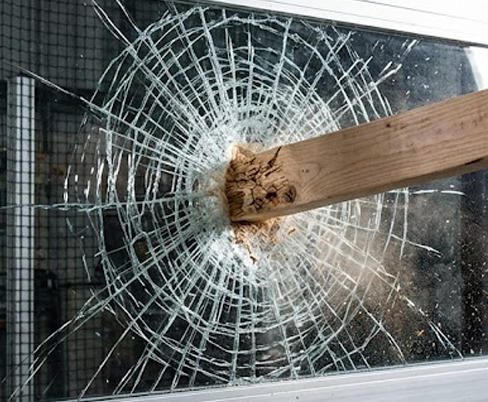
In hurricane-prone coastal environments, wind-borne debris frequently causes catastrophic envelope failures before peak wind reached. The large missile impact test protocol addresses this directly by firing a timber member at the assembly at a defined velocity, simulating the kind of airborne projectile a real storm can generate. Critically, passing the strike phase alone is insufficient. Directly following the impact event, the assembly must also survive cyclic pressure loading — thousands of alternating positive and negative pressure cycles that replicate the fluctuating aerodynamic forces of an actual hurricane. The acceptance criteria focus on retention rather than perfection: the laminated glass may fracture, but it must remain captured within the frame, and the assembly must not create an opening into the building interior. This is where laminated glass construction and precision frame engineering prove decisive for hurricane rated glass garage doors, because the test is explicitly measuring post-fracture retention, not intact glass survival. Standards including TAS 201, TAS 202, and TAS 203 govern these evaluations in Florida jurisdictions.
Impact Resistance: Testing What Wind-Borne Debris Actually Does

Product Approvals: Translating Test Data Into Jurisdictional Compliance

A laboratory test report constitutes evidence of performance. What a building official actually accepts at permit submission is a formal product approval. Under the Florida Building Code, approvals are issued through the state's Florida Product Approval system, which covers the majority of the state. However, the High Velocity Hurricane Zone (HVHZ) — encompassing Miami-Dade and Broward counties — operates under a more rigorous separate framework governed by the Miami-Dade Notice of Acceptance (NOA). For architects working in either regime, the practical obligation is to verify that the approval on file matches the actual project conditions: the approved opening dimensions, the specific glazing assembly build-up, and the required anchorage details must all align with what is being installed. A rating that was established for a smaller opening or a different substrate configuration does not automatically transfer. bp's Hurricane Line is available for HVHZ-level protection, and approval documentation should always be cross-referenced against the specific project opening by the engineer of record before any specification is finalized. Project teams in Florida can confirm jurisdiction-specific requirements directly through the product approval system.
Product Approvals: Translating Test Data Into Jurisdictional Compliance

Frequently Asked Questions

A wind rating documents the design pressure — expressed in psf — that the complete door assembly successfully withstood during a controlled structural test, evaluated under both inward (positive) and outward (negative) loading. It measures the combined performance of the glazing, frame, track system, and anchorage under wind-induced force. It does not address impact resistance, which requires entirely separate test protocols.

A wind-load rating is derived from structural pressure testing and establishes how much force the assembly can carry in each direction. An impact rating confirms that the assembly survived a large missile impact followed by sustained cyclic pressure loading. These are distinct evaluations — a product can hold a wind-load rating without any impact qualification. Hurricane region projects typically mandate both, which is the application context for bp's Hurricane Line.

No. A Miami-Dade NOA is a comprehensive product approval issued under the High Velocity Hurricane Zone protocols. It incorporates structural, impact, and cyclic pressure testing results alongside explicitly defined size limits, glazing specifications, and anchorage requirements. A wind rating is a single data point from one test. The NOA is the binding approval document that makes that data enforceable within the jurisdiction.

Not necessarily. The figure that governs specification is the design pressure calculated for that specific opening, derived from the project location, exposure category, and building geometry. The rated assembly simply needs to meet or exceed that calculated value. A higher-rated product may be appropriate in some cases, but the calculated site demand is always the controlling reference point.

Yes. Impact test standards are built around the principle of post-fracture retention, not intact survival. The glazing is permitted to crack during the missile strike and subsequent cyclic loading, provided it remains fully captured within the frame and the assembly does not create a breach into the building interior. This is precisely why laminated glass construction and engineered frame systems — not raw glass thickness alone — determine the outcome.