Assessing Durability and Performance in Contemporary Glass Overhead Systems
A glass panel of substantial size that operates multiple times daily, enduring direct sunlight, fluctuations in temperature, and constant movement, presents a distinct engineering challenge when compared to a traditional fixed window. Nevertheless, numerous glass overhead systems available today are still conceived and assessed as if they are equivalent. A crucial factor (and often the one that remains obscure to specifiers) is the method of securing glass within its frame: whether it is mechanically secured or adhered with structural bonding agents.
This distinction is not merely aesthetic. It signifies the outcome between a door that deteriorates in a predictable manner over years and another whose retention approach progressively weakens whenever temperature shifts and stress are applied. Below, we analyze the underlying materials at play, elucidating why mechanical retention is the accepted standard that commercial specifications increasingly mandate, a standard upon which bp Glass Garage Doors & Entry Systems has established its proprietary NFRC-certified frame system.
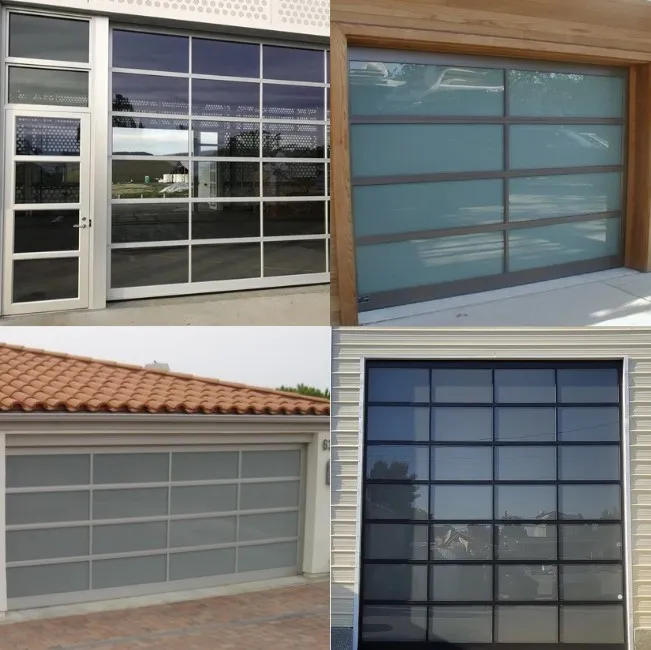
Durability Considerations in Glass Overhead Systems
Our core competencies
Impact of Thermal Fluctuations and the Challenges Faced by Adhesive Bonds in Overhead Doors
The Effects of UV Radiation on Long-Term Efficacy of Structural Adhesives
Reassessing the Safety Landscape for Overhead Installations through Mechanical Retention
See Our Process
How we deliver exceptional results
Common Questions
While structural silicone glazing has proven effective in fixed vertical positions where panels remain static, the scenario is markedly different for overhead doors where the adhesive plays a pivotal role under stress from consistent thermal variations and operation.
This can greatly differ based on factors such as climate, adhesive make-up, and direct sun exposure, complicating the picture. Manufacturers who can provide reliable, independent whole-assembly test data lend specifiers a concrete basis for comparison; vague adhesive performance claims fall short.
Complete assembly testing and certifications, wherein the frame, glass, and retention methods are verified collectively. This is the fundamental basis for the NFRC whole-assembly accreditation, and demanding this standard is sensible regardless of the retention strategy a manufacturer employs. bp's Insulated Line and Hurricane Line both adhere to this whole-assembly certification—a benchmark that should be pursued from all manufacturers.
Certainly, any glazing or entrance solution may malfunction if designed poorly or incorrectly installed. However, the crux of the matter is the predictability of failure modes: mechanical retention system issues are tangible, quantifiable, and rectifiable during standard inspections, unlike the hidden chemical decline exhibited by adhesive connections that can go unnoticed until catastrophic failure occurs. Understanding long-term structural vulnerabilities is why specifiers and project engineers favor robust high-performance products from bp - Glass Garage Doors, crafted with confirmable mechanical assemblies and thermal efficiencies integrated into their designs.
Yes, products that do not feature verifiable third-party whole-assembly certifications increase the performance burden on the building owner's maintenance rather than being the responsibility of the manufacturer's design. It is crucial to raise these concerns during the specifications’ development rather than post-installation.